

January 30, 2026
The Impact of Perth’s Climate on Waterproofing: What You Must Know
If you live in Perth for years, you stop comparing the weather to the rest of Australia. It’s unpredictable. Summers roast forever, the sun feels closer than it should, and winter doesn’t ease in gently; it arrives with a punch. This combination creates problems most people don’t think about until something leaks.
Waterproofing for walls is one of those things that looks fine… until it isn’t. And in Perth-based homes, when it fails, it often fails earlier and harder than expected. Not because someone necessarily did a bad job, but because the weather conditions here quietly chew through materials that perform just fine elsewhere.
Understanding how climate affects, how waterproofing helps you avoid expensive mistakes, and whether you’re building, renovating, or trying to protect a home you plan to keep long term.
The Sun Does More Damage Than People Realise
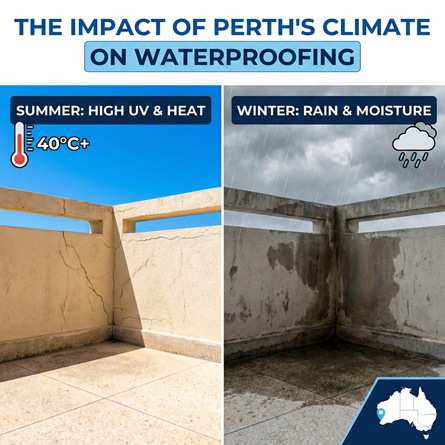
Everyone knows summers in Perth are brutal. What’s less obvious is what the sun does beneath the surface. UV doesn’t just fade paint. It attacks the chemistry of waterproofing membranes themselves.
Over time, the sun breaks down the bonds that keep membranes flexible. They stiffen. They lose elasticity. Eventually, they crack. It’s the same reason plastic outdoor furniture goes brittle after years outside, except here, that material is supposed to keep water out of your home.
In cooler southern cities, a membrane might stay flexible for over a decade. In Perth, that same product can start showing problems in half the time, especially on west-facing walls and flat roof areas that cop afternoon heat day after day. Those surfaces don’t just get warm, they get hot enough to accelerate ageing.
The early signs are easy to miss. A chalky surface. Fine hairline cracks. Slight separation at edges. Ignore it, and the membrane slowly loses its ability to do the one job it exists for.
That’s why “suitable for outdoor use” isn’t enough here. Products need proper UV stabilisation designed for high-exposure environments, not just a generic label.
Heat Movement Slowly Pulls Waterproofing Apart
Perth’s daily temperature swings are brutal on buildings. A balcony slab can be cool in the morning and hot enough to fry an egg by mid-afternoon. That expansion and contraction happen every single day through the summer.
The real stress shows up where materials meet. Concrete moves differently from brick. Metal moves more than both. Waterproofing is expected to stretch across those junctions and keep everything sealed while the structure shifts underneath it.
Over time, that constant movement takes its toll. Edges start to lift. Seals lose their grip. If the membrane has already hardened from UV exposure, cracking becomes almost inevitable.
Dark surfaces and metal elements make things worse. They hold heat longer and reach higher temperatures, creating localised hot spots where waterproofing ages faster than the surrounding areas. Some membranes soften and sag under sustained heat. Others do the opposite and become rigid. Either way, performance drops long before anyone notices a leak.
Rainfall in Perth Creates Unique Pressure Points
Perth waterproofing sits dry for months on end. No rain. No moisture. Just sun and heat slowly change the material.
Then winter arrives.
The first proper rain often comes suddenly and heavily. Any tiny cracks formed during the dry months are now open invitations for water. Seals that pulled away slightly now let moisture creep in behind the membrane, where you can’t see it until damage shows up inside.
And when Perth gets rain, it doesn’t mess around. Short, intense downpours load drainage systems fast. Water backs up. Pressure builds. Weak points that survive light rain fail under volume.
That long dry stretch followed by sudden saturation is something waterproofing systems in other parts of Australia rarely deal with.
Climate Factor | How Long Does It Last | What It Does to Waterproofing | How Failure Happens |
Strong UV | 8 to 10 months of intense exposure | Breaks down the polymer structure | Materials crack and go chalky, lose their flex |
Heat over 35°C | 4 to 5 months each year | Causes expansion and contraction cycles | Seals pull away, stress cracks appear |
Heavy downpours | 10 to 15 events each winter | Creates water pressure and saturation | Water gets through areas already weakened |
Long dry spells | 6 to 7 months with barely any rain | Materials harden and can shrink slightly | Gaps open up, connections separate |
Picking Products That Don’t Give Up Early
Not all waterproofing products belong in Perth, even if they’re sold here.
The first thing to look for is proven UV resistance, backed by testing, not marketing language. If a data sheet doesn’t clearly state performance under high UV exposure, that’s a gamble.
Heat tolerance matters just as much. Exposed surfaces regularly exceed air temperature by a long way. If a product hasn’t been tested at extreme surface temperatures, it’s not designed for local reality.
Flexibility is critical. Membranes need serious stretch capacity to survive thermal movement. Anything under about 200% elongation is asking for trouble, especially once UV ageing is factored in.
In practice, higher-grade polyurethane systems with proper UV stabilisers tend to perform better here. They cost more upfront, but they age more slowly and fail later. Liquid-applied systems also handle Perth conditions better than sheet membranes in complex areas because they eliminate seams, and seams are where problems usually start.
Where Perth Homes Fail First
Balconies are ground zero. Full sun, heavy rain, foot traffic, furniture movement, all stacked together. Poor falls and pooling water speed up damage fast.
Parapets are another weak spot. Horizontal cappings heat and cool faster than the walls below them, stressing the junction between the two. Add wind-driven rain, and any weakness gets exposed quickly.
Penetrations are constant offenders. Pipes, cables, and fixings are all moving at different rates relative to the membrane around them. Cheap sealants don’t survive the Perth sun for long. When they harden or shrink, water finds a way in.
Box gutters cop it worst during winter storms. When rain hits hard, undersized gutters overflow, forcing water back against waterproofing that’s already been baked all summer. If the membrane hasn’t been run high enough or isn’t heat-resistant, failure isn’t far away.
Getting The Right Installation in WA
Trying to waterproof in extreme heat is asking for adhesion issues. Materials skin over too quickly. Bonding suffers. Once surface temperatures climb past a certain point, problems are almost guaranteed.
Rain creates the opposite problem: moisture trapped before curing.
The best installation windows in Perth are in autumn and spring. Temperatures are manageable, rain risk is lower, and membranes cure properly. It requires planning, but skipping this step often costs more later.
Surface prep matters more here, too. Any contamination or residual moisture gets punished by thermal cycling. Primers stop being optional. They’re insurance.
Corners, edges, penetrations, this is where experience reflects. Reinforcement, overlaps, secondary seals, none of it’s glamorous, but it’s what separates systems that last from ones that don’t.
Maintenance Is What Keeps Waterproofing Alive
Perth waterproofing needs checking. Not obsessively, just sensibly.
A once-a-year inspection before the winter season can catch early UV damage, edge lifting, or seal failure before rain gets involved. Small repairs done early save serious money later.
What to Check | Look For | What to Do | When |
Surface condition overall | Cracks, bubbles, colour changes | Keep track of small issues, fix anything significant | April each year |
Water drainage | Clear outlets, proper slopes, no standing water | Clear out blockages, fix slopes if necessary | Before the first winter rain arrives |
Seals around penetrations | Gaps opening up, sealant getting hard, pulling away | Redo seals with UV-resistant sealant | At least every two years |
UV wear | Chalky surface, brittleness, surface breaking down | Put on protective coating or start planning replacement | As soon as you notice chalking |
What’s Coming for Waterproofing in Perth
Perth summers are getting hotter. Rain events are getting heavier. That means waterproofing will be under even more stress in the years ahead.
Minimum standards may not be enough. Many builders and owners like Waterproofing Perth are already going beyond them, using better products, adding redundancy in high-risk areas, and designing with drainage capacity in mind.
The takeaway is simple: waterproofing in Perth isn’t something you can treat as generic. It has to be chosen, installed, and maintained with local conditions in mind. When it is, buildings last longer and perform better. When it isn’t, the climate eventually wins, and the repairs are never cheap.